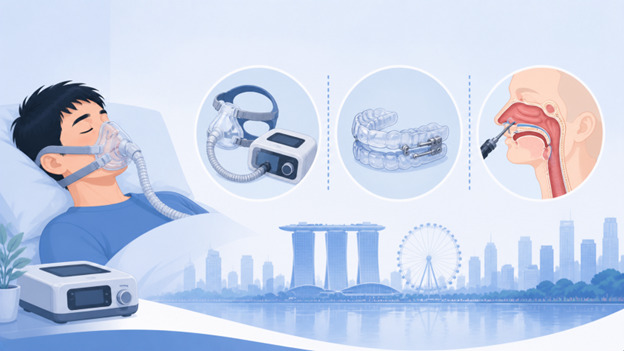
CPAP, Oral Appliances, and Surgery: An ENT Specialist's Treatment Toolkit for Sleep Apnea in Singapore
Introduction: One Diagnosis, Many Paths to Healing
By now, you have made it through the diagnostic journey. You have completed your home sleep test or in-lab polysomnography. You have sat across from an ENT specialist who explained your Apnea-Hypopnea Index (AHI), your oxygen nadir, and perhaps the results of drug-induced sleep endoscopy (DISE). You now know with certainty: you have sleep apnea.
Now comes the most important question: What do we do about it?
The answer is not one-size-fits-all. Sleep apnea is a highly individual condition. Your anatomy, your severity, your lifestyle, your preferences, and your tolerance for different devices all matter. The good news is that Singapore offers a complete range of sleep apnea treatments. From non-invasive devices to surgical cure, an ENT specialist can guide you through every option.
This article is the third in our four-part series on sleep apnea in Singapore. You will learn about every major treatment category: lifestyle modifications, continuous positive airway pressure (CPAP), oral appliances, positional therapy, and surgical interventions including the latest advances like hypoglossal nerve stimulation. By the end, you will understand the pros and cons of each approach and be ready to make an informed decision with your ENT specialist.
Let us begin with the treatment that requires no equipment, no medication, and no surgery: lifestyle change.
Lifestyle Modifications – The Foundation of All Sleep Apnea Care
Why Lifestyle Matters, Even with Severe Apnea
Before discussing devices and surgeries, it is essential to understand that lifestyle modifications are not optional extras. They are the foundation upon which all other sleep apnea treatments rest. Even if you ultimately need CPAP or surgery, improving your lifestyle will enhance the effectiveness of those treatments and may reduce the intensity of therapy you require.
Your ENT specialist will discuss several lifestyle targets. None of them are quick fixes, but all of them produce meaningful improvements over weeks to months.
Weight Loss – The Single Most Effective Non-Device Intervention
Obesity is the strongest modifiable risk factor for sleep apnea. Excess fat deposits in the neck and around the upper airway physically narrow the throat. Fat in the abdomen pushes upward on the diaphragm, reducing lung volume and making airway collapse more likely.
The relationship between weight and sleep apnea is linear: the more you weigh, the worse your apnea. But the reverse is also true. Losing just 10% of your body weight can reduce your AHI by 25-50%. For a patient with moderate sleep apnea (AHI 25), a 10% weight loss might bring them down to mild sleep apnea (AHI 15) – potentially avoiding CPAP altogether.
In Singapore, weight loss support is available through:
- Health Promotion Board’s Healthy Living programmes (free or low-cost)
- Polyclinic weight management clinics (subsidized dietitian consultations)
- Private dietitians and nutritionists ($80-150 per session)
- Commercial programmes (Weight Watchers, NOVI Optimum, etc.)
- Bariatric surgery for patients with BMI > 35 and severe sleep apnea (discussed later)
Your ENT specialist is not a weight loss expert, but they can refer you to the right resources. Losing weight is hard. But treating sleep apnea without addressing weight is like bailing water from a leaky boat without plugging the hole.
Sleep Positioning – A Free and Simple Intervention
For many patients, sleep apnea is significantly worse when they sleep on their back (supine position). In supine sleep, gravity pulls the soft palate, tongue, and other structures backward into the throat. In side sleeping, gravity works in your favor, keeping the airway more open.
How do you know if you are a supine-predominant patient? Your sleep study report will include a supine AHI and a non-supine AHI. If your supine AHI is more than twice your non-supine AHI, you are a positional patient.
Positional therapy is simple: train yourself to sleep on your side. Methods include:
- Tennis ball technique: Sew a tennis ball into the back of a t-shirt or purchase a commercial positional alarm device. When you roll onto your back, the discomfort wakes you enough to roll back to your side.
- Pillow systems: Special wedge pillows or body pillows make side sleeping more comfortable.
- Elevating the head of the bed: Raising the head of your bed by 4-6 inches (using blocks under the bed legs, not just pillows) can reduce upper airway collapse for some patients.
Positional therapy alone is rarely sufficient for moderate to severe sleep apnea, but it can reduce the pressure needed for CPAP or make an oral appliance more effective.
Alcohol, Sedatives, and Smoking – What to Avoid
Alcohol is a potent muscle relaxant. Drinking alcohol within 3-4 hours of bedtime relaxes the throat muscles more than natural sleep alone, worsening sleep apnea severity by 25-50% on drinking nights. Your ENT specialist will advise avoiding alcohol entirely or limiting it to early evening hours only.
Sedatives and sleeping pills (benzodiazepines, Z-drugs like zolpidem, antihistamines) have similar effects. They suppress arousal responses, meaning you may have longer apnea episodes without waking up to breathe. This leads to more severe oxygen drops. If you take sedatives for insomnia, ask your ENT specialist or GP about alternatives that are safer for sleep apnea patients.
Smoking irritates and inflames the upper airway, causing swelling that narrows the throat. Smokers have higher AHI scores than non-smokers of the same weight. Quitting smoking improves sleep apnea severity and overall health. Singapore’s Health Promotion Board offers free smoking cessation counselling and subsidised nicotine replacement therapy.
Continuous Positive Airway Pressure (CPAP) – The Gold Standard Treatment
What Is CPAP and How Does It Work?
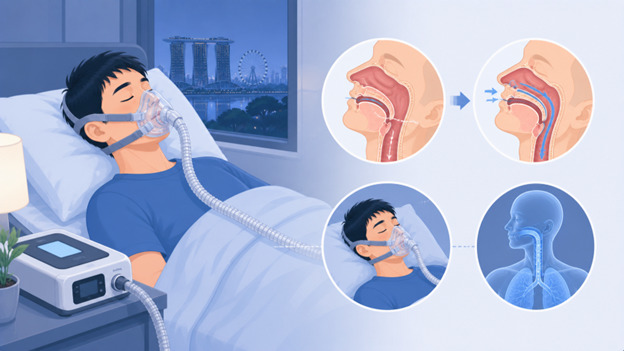
CPAP is the most effective non-surgical treatment for sleep apnea. A CPAP machine is a small, quiet blower that sits on your bedside table. A heated humidifier adds moisture to the air. A flexible tube connects the machine to a mask that you wear over your nose, or nose and mouth, while you sleep.
Here is the simple but powerful mechanism: the CPAP machine generates a continuous stream of pressurized air. That pressure travels down your airway and acts as a pneumatic splint – an invisible column of air that holds your throat open. No matter how relaxed your muscles become, the pressurized air keeps the airway patent. Snoring stops. Apneas stop. Oxygen levels normalise.
The required pressure is unique to each patient. Your ENT specialist or sleep physician will determine your pressure through a process called CPAP titration. This is often performed during a split-night sleep study: you sleep without CPAP for the first half of the night to confirm the diagnosis, then the technologist applies CPAP for the second half to find the optimal pressure.
Types of CPAP Masks – Finding Your Perfect Fit
The mask is the most critical factor in CPAP success. An uncomfortable mask leads to non-adherence. A comfortable mask leads to life-changing results. Your ENT clinic or CPAP provider should offer mask fitting sessions where you try multiple options.
Nasal mask: Covers the nose only. Best for patients who do not breathe through their mouth during sleep. Lightweight, less claustrophobic, and fewer leaks than full-face masks.
Nasal pillows mask: Small silicone pillows that seal against the nostrils. Very minimal contact, excellent for patients who feel claustrophobic or have facial hair. Not suitable for high pressures.
Full-face mask: Covers both nose and mouth. Essential for patients who breathe through their mouth during sleep (common with chronic nasal congestion). Can feel bulky and may leak more easily.
Hybrid mask: Combines nasal pillows with a mouth covering. Less bulk than full-face but still seals the mouth.
Most CPAP providers in Singapore (including those affiliated with ENT clinic practices) offer mask trials. You may be able to take masks home for a few nights before purchasing.
Common CPAP Problems and Solutions
Despite its effectiveness, 30-50% of patients stop using CPAP within the first year. Your ENT specialist wants you to succeed. Here are common problems and fixes:
| Problem | Solution |
|---|---|
| Dry mouth or nose | Add heated humidification. Increase humidity setting. Use saline spray before bed. |
| Mask leaks | Try a different mask size or style. Use mask liners (soft fabric between mask and skin). |
| Claustrophobia | Start with nasal pillows. Wear the mask while awake (watching TV, reading) to desensitize. |
| Difficulty exhaling against pressure | Ask about pressure relief features (Expiratory Pressure Relief – EPR or C-Flex). Consider BiPAP instead. |
| Noise from the machine | Newer machines are very quiet (under 30 decibels). Place the machine on a soft surface or under the bed. |
| Air swallowing (aerophagia) | Reduce pressure slightly if clinically appropriate. Sleep with head elevated. |
| Cannot fall asleep with mask | Practice mask use during the day. Use CPAP ramp feature (starts at low pressure, gradually increases). |
Getting a CPAP Machine in Singapore
CPAP machines and masks are available in Singapore through:
- Public hospitals (subsidised for patients with confirmed sleep apnea and polyclinic referral)
- Private CPAP providers (e.g., CPAP Singapore, Asia Sleep Centre, Respiratory Sleep Solutions)
- Some ENT clinic practices (direct dispensing)
Costs in Singapore (private, not subsidised):
| Item | Estimated Cost |
|---|---|
| CPAP machine (basic) | $800 – $1,500 |
| CPAP machine (auto-adjusting) | $1,500 – $3,000 |
| CPAP mask | $150 – $400 |
| Heated humidifier (built into most modern machines) | Included |
| Replacement mask cushions (every 3–6 months) | $30 – $80 |
| Replacement tubing (every 6–12 months) | $20 – $50 |
| Replacement filters (monthly) | $5 – $15 |
Subsidised CPAP: Through public hospitals, Singapore citizens with a valid referral can obtain CPAP at 50-80% subsidy. The out-of-pocket cost may be $200-500 for the machine, plus monthly rental fees for the first few months.
Many private insurance plans in Singapore (integrated shield plans) cover CPAP machines partially or fully after diagnosis. Check with your insurer.
Oral Appliances – A CPAP Alternative for Mild to Moderate Apnea
What Are Oral Appliances?
Oral appliances (also called mandibular advancement devices or MADs) are custom-fitted mouthpieces worn during sleep. They look similar to sports mouthguards or orthodontic retainers. The appliance holds your lower jaw (mandible) slightly forward relative to your upper jaw. Because your tongue attaches to the lower jaw, moving the jaw forward pulls the tongue away from the back of the throat, opening the airway.
Oral appliances are effective primarily for patients with mild to moderate sleep apnea (AHI 5-30) and for those with positional or tongue-base collapse patterns identified on DISE.
Custom-Fitted vs. Boil-and-Bite Appliances
There are two categories of oral appliances:
Boil-and-bite (over-the-counter): Available online or in pharmacies for $50-150. You soften the material in hot water, bite down to create an impression, and cool. These are not recommended by ENT specialist physicians. They can cause jaw pain, tooth movement, and are rarely effective because they do not provide precise advancement.
Custom-fitted (by dentist or ENT specialist): Your ENT specialist or a collaborating dental sleep specialist takes digital scans or impressions of your teeth. A dental laboratory fabricates a precise appliance that fits perfectly. These cost 1,500 to 3,500 but are effective, comfortable, and safe for long-term use.
Pros and Cons of Oral Appliances
| Pros | Cons |
|---|---|
| No machine, no electricity, no noise | Only effective for mild to moderate apnea (typically AHI < 30) |
| Extremely portable (fits in a small case) | Requires healthy teeth and gums to anchor the device |
| Easy to use while travelling | Can cause jaw pain, tooth soreness, or bite changes |
| No mask or headgear | May worsen TMJ (jaw joint) problems |
| High adherence rates (70–80% long-term use) | Not suitable for patients with severe apnea or central apnea |
Your ENT specialist can refer you to a qualified dental sleep specialist in Singapore for appliance fitting. Many ENT clinic practices have an affiliated dentist on-site or in the same building.
Positional Therapy Devices – Simple Solutions for Positional Apnea
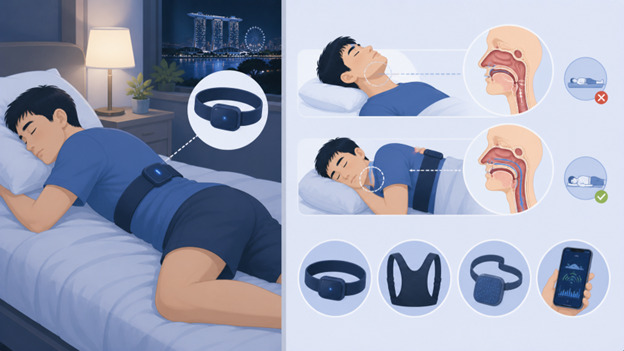
For patients with supine-predominant sleep apnea (supine AHI at least twice non-supine AHI), positional therapy may be sufficient as monotherapy for mild cases or as an adjunct to other treatments.
Commercial positional devices available in Singapore include:
- NightShift: A wearable device worn around the neck that vibrates gently when you roll onto your back.
- Sona pillow system: A pillow with an inflatable chamber that encourages side sleeping.
- Aurora Positional Therapy: A lightweight belt with a sensor that vibrates on back sleeping.
Surgical Treatments – When Non-Invasive Options Fail
Who Is a Candidate for Sleep Apnea Surgery?
Surgery for sleep apnea is not a first-line treatment. Your ENT specialist will consider surgery only if:
- You have failed CPAP (cannot tolerate it or refuse to use it)
- You have failed oral appliance therapy
- You have a surgically correctable anatomical abnormality clearly identified on DISE
- You have severe sleep apnea with complications (oxygen drops below 80%, heart arrhythmias)
- You have a body mass index (BMI) below 35 (surgery is less effective in obesity)
The goal of sleep apnea surgery is not always to cure the condition entirely. More often, the goal is to reduce the AHI to a level where CPAP pressure can be lowered, or to convert a patient from severe to moderate apnea where an oral appliance becomes effective.
Nasal Surgery – Improving the Gateway
Nasal obstruction from a deviated septum, enlarged turbinates, or nasal polyps does not cause sleep apnea on its own (the primary site of collapse is behind the nose). However, nasal obstruction forces mouth breathing, which worsens collapse. Nasal surgery alone reduces AHI by only 10-20%, but it can significantly improve CPAP tolerance.
Procedures include:
- Septoplasty: Straightening the deviated septum
- Turbinate reduction: Shrinking swollen nasal tissues (radiofrequency, coblation, or microdebrider)
- Polypectomy: Removing nasal polyps
These procedures are performed through the nostrils (endoscopic) with no external incisions. Recovery is 1-2 weeks of congestion and mild bleeding. Most are day surgeries (go home the same day).
Palate Surgery (UPPP, LAUP, Expansion Sphincter Pharyngoplasty)
If DISE shows palatal collapse as the primary problem, palate surgery may help. The most common procedure is uvulopalatopharyngoplasty (UPPP) , which removes the uvula, trims the soft palate, and tightens the palatal muscles.
Newer, more effective techniques include:
- Expansion sphincter pharyngoplasty (ESP): Repositions the palatal muscles laterally to widen the airway. Preferred over traditional UPPP by modern ENT specialist surgeons.
- Lateral pharyngoplasty: Similar concept – opens the lateral walls of the throat.
- Relocation pharyngoplasty: Another modification of UPPP with better outcomes.
Palate surgery reduces AHI by 50-60% on average. For carefully selected patients (palate-only collapse, BMI < 30), success rates (defined as AHI < 20 and 50% reduction) reach 70-80%.
Recovery from palate surgery is notoriously painful (7-10 days of significant throat pain, similar to a bad tonsillectomy). Patients need liquid or soft diets for 1-2 weeks. There is a small risk of velopharyngeal insufficiency (nasal regurgitation of liquids or nasal-sounding speech). Your ENT specialist will discuss these risks in detail.
Tongue Base Surgery
For patients with tongue base collapse on DISE, the tongue is the culprit. Tongue base reduction can be achieved through:
- Radiofrequency ablation of the tongue base: A needle electrode is inserted into the tongue under general anesthesia. Radiofrequency energy shrinks the tissue over several weeks. Minimal pain, no external scars. Effective for mild to moderate tongue base collapse. Costs $5,000-8,000.
- Midline glossectomy: Surgical removal of a strip of tissue from the central tongue. More invasive, more pain, but more effective for severe cases.
- Hyoid suspension: The hyoid bone (at the base of the tongue) is sutured forward to the thyroid cartilage, pulling the tongue base away from the throat. Often combined with other procedures.
Hypoglossal Nerve Stimulation (HGNS) – The Latest Breakthrough
This is the most exciting development in sleep apnea surgery in the last decade. HGNS (brand name Inspire) is essentially a “pacemaker for the tongue.” A small, battery-powered implantable device is placed under the skin of the upper chest during outpatient surgery. A sensing lead is placed between the ribs to detect breathing effort. A stimulation lead is wrapped around the hypoglossal nerve (the nerve that controls tongue protrusion).
Here is how it works: When you exhale, the device senses the breathing effort and does nothing. When you inhale, the device delivers a mild electrical pulse to the hypoglossal nerve, causing the tongue to stiffen and move forward slightly – just enough to keep the airway open. You cannot feel the stimulation while asleep.
Who is a candidate for HGNS?
- AHI between 15 and 65 (moderate to severe sleep apnea )
- BMI less than 32 (obesity reduces effectiveness)
- No complete concentric collapse of the palate on DISE (this pattern does not respond well)
- Failed CPAP (cannot tolerate or refuse)
Outcomes: In clinical studies, HGNS reduced AHI by an average of 68-75%. Two-thirds of patients achieve an AHI below 20. Snoring is eliminated or dramatically reduced. Patients wake up without a mask, without a machine, and without oral appliances.
Maxillomandibular Advancement (MMA) – The Most Effective but Most Invasive
MMA is major jaw surgery. The upper jaw (maxilla) and lower jaw (mandible) are cut, moved forward as a single unit, and fixed with titanium plates and screws. Moving both jaws forward pulls the entire tongue base and soft palate away from the throat, dramatically enlarging the airway.
Results: MMA is the most effective surgical treatment for sleep apnea. Success rates (AHI < 20 and 50% reduction) exceed 85-90%. Many patients achieve an AHI below 5 – a complete cure.
The catch: MMA requires general anaesthesia, a 1-2 night hospital stay, 4-6 weeks of liquid/soft diet, and 6-8 weeks before returning to full activity. Most patients need orthodontics (braces) before and after. MMA is reserved for patients with severe sleep apnea who have failed all other treatments.
Bariatric Surgery for Obesity-Related Sleep Apnea
For patients with severe obesity (BMI > 35) and sleep apnea, gastric bypass or sleeve gastrectomy is not a sleep apnea surgery per se, but it is a powerful treatment. Weight loss of 30-50% of excess body weight after bariatric surgery reduces AHI by 50-75%. Some patients achieve complete remission.
In Singapore, bariatric surgery is available at public and private hospitals. Public subsidies apply for Singapore citizens with BMI > 37.5 (or > 32 with obesity-related complications like sleep apnea ).
Choosing Your Path – A Decision Framework
With so many options, how do you choose? Your ENT specialist can help, but here is a framework to guide the conversation:
Step 1: Know your severity
- AHI 5-15 (mild): Lifestyle changes + positional therapy + oral appliance (optional), CPAP (optional)
- AHI 15-30 (moderate): CPAP or oral appliance or HGNS (selected patients)
- AHI >30 (severe): CPAP strongly recommended; consider HGNS or MMA if CPAP fails
Step 2: Know your anatomy (from DISE)
- Palate-only collapse → Palate surgery (ESP) may cure or greatly improve
- Tongue base collapse → Oral appliance or tongue base surgery or HGNS
- Complete concentric palatal collapse → CPAP or MMA; tongue surgery not effective
- Multilevel collapse → Combination therapy or HGNS or MMA
Step 3: Know your preferences and tolerance
- Willing to wear a mask every night? → CPAP
- Cannot tolerate a mask but okay with mouthpiece? → Oral appliance
- Refuse all devices but okay with surgery? → Surgical evaluation
- Failed everything? → HGNS or MMA
Conclusion – There Is a Solution for Everyone
Sleep apnea is a treatable condition. There is no excuse for suffering in silence. Whether you choose lifestyle changes, CPAP, an oral appliance, positional therapy, or surgery, your ENT specialist in Singapore can guide you to the right option.
Many patients fear CPAP but find after a few weeks that they cannot imagine sleeping without it. Others cannot tolerate CPAP at all but thrive with an oral appliance or HGNS. Some patients undergo surgery and wake up for the first time in years feeling truly rested.
Your journey starts with a single step: booking that ENT clinic appointment. Bring your sleep study results. Bring your questions. Bring your willingness to try something new. Your ENT specialist will meet you there.
In Article 4 of this series, we will discuss long-term success – how to monitor your treatment, how to maintain your weight loss, and how to live fully with sleep apnea in Singapore.
But for now, choose a path and start walking. Your better sleep is waiting.