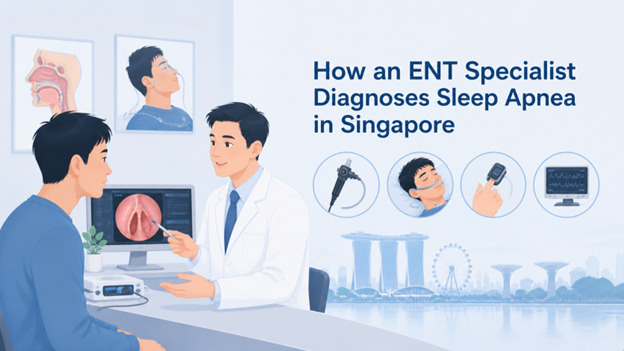
Beyond the Snore: How an ENT Specialist Diagnoses Sleep Apnea in Singapore
Introduction: From Suspicion to Certainty
In Article 1, you learned that Singapore is in the midst of a sleep apnea crisis. You discovered the risk factors, the warning signs, and the STOP-BANG questionnaire that helps identify who needs further evaluation. But suspicion is not the same as diagnosis. Knowing you might have sleep apnea is very different from knowing for certain – and knowing the severity.
This is where an ENT specialist becomes indispensable. Diagnosing sleep apnea is not a single test but a process. It involves ruling out other conditions, measuring the frequency and depth of breathing pauses, assessing oxygen levels, and evaluating the anatomy of your airway. Only with all this information can your ENT specialist recommend the right treatment for your specific case.
This article is the second in our four-part series on sleep apnea in Singapore. You will learn about the diagnostic tools available in local ENT clinic settings, from simple home sleep tests to sophisticated in-lab studies and a specialized procedure called drug-induced sleep endoscopy. By the end, you will understand exactly what happens when you pursue a sleep apnea diagnosis in Singapore – and what the numbers mean for your health.
Let us begin with the most common first step: the home sleep test.
The Diagnostic Journey – Where to Start
The Role of Your ENT Specialist vs. Your GP
Before diving into tests, it is worth understanding how different providers fit into the diagnostic pathway. In Singapore, both general practitioners (GPs) and ENT specialist physicians can order sleep apnea testing. However, their roles and expertise differ significantly.
A GP can:
- Administer the STOP-BANG questionnaire
- Suspect sleep apnea based on symptoms
- Order a home sleep test (HST)
- Prescribe a CPAP machine if the HST confirms moderate to severe sleep apnea
An ENT specialist can do all of the above, plus:
- Perform nasal endoscopy to visualize airway anatomy
- Identify surgically correctable causes of sleep apnea (large tonsils, deviated septum, nasal polyps)
- Order specialized tests like drug-induced sleep endoscopy (DISE)
- Offer the full range of treatment options, including oral appliances, CPAP, and surgery
For straightforward, uncomplicated sleep apnea, a GP-led pathway is acceptable. But for patients with complex anatomy, failed CPAP trials, or interest in non-CPAP options, an ENT clinic provides a higher level of care. Many Singaporeans choose to see an ENT specialist first precisely because of this comprehensive approach.
Ruling Out Other Causes of Your Symptoms
Before ordering a sleep apnea test, your ENT specialist will consider whether your symptoms could be caused by something else. Many conditions mimic sleep apnea or occur alongside it:
- Chronic nasal obstruction from allergies, polyps, or a deviated septum can cause mouth breathing and snoring that sounds like apnea
- Gastroesophageal reflux disease (GERD) can wake you with coughing or choking sensations
- Insomnia with anxiety can cause unrefreshing sleep and daytime fatigue
- Restless legs syndrome (RLS) can fragment sleep without airway obstruction
- Narcolepsy causes severe daytime sleepiness but different nighttime patterns
Your ENT specialist will take a thorough history to distinguish these possibilities. Nasal endoscopy is particularly valuable here – it can instantly rule in or rule out structural nasal problems as the primary issue. If your examination is completely normal, the focus shifts strongly toward sleep apnea testing.
Home Sleep Testing – The Convenient First Step
What Is a Home Sleep Test?
A home sleep test (HST), also called a home sleep apnea test (HSAT), is exactly what it sounds like: a simplified sleep study that you perform in your own bed. The equipment is portable, battery-powered, and designed to be user-friendly. You pick up the device from your ENT clinic or a sleep center, watch a short instructional video, and take it home for one or two nights.
A typical HST measures:
- Nasal airflow (via a small cannula that sits under your nose)
- Respiratory effort (elastic belts around your chest and abdomen that sense breathing movements)
- Oxygen saturation (a finger clip pulse oximeter)
- Heart rate (from the same finger clip)
- Body position and snoring intensity (via a built-in sensor or position marker)
Unlike a full in-lab sleep study, an HST does not measure brain waves (EEG), eye movements (EOG), muscle tone (EMG), or leg movements. This means an HST cannot tell you how much REM and deep sleep you are getting, nor can it rule out other sleep disorders like narcolepsy or RLS.
Who Is a Good Candidate for Home Testing?
Your ENT specialist will recommend an HST if you meet certain criteria:
- High pre-test probability of moderate to severe sleep apnea (STOP-BANG score 3 or higher)
- No significant other medical conditions (especially heart or lung disease)
- No suspicion of other sleep disorders
- Able to follow the instructions for setting up the equipment
HST is generally not recommended for patients with:
- Congestive heart failure or chronic obstructive pulmonary disease (COPD)
- Neuromuscular diseases (ALS, muscular dystrophy)
- Suspected central sleep apnea
- Significant insomnia or other sleep disorders
How to Complete a Home Sleep Test in Singapore
The process in a Singapore ENT clinic typically follows these steps:
- Consultation: Your ENT specialist determines that HST is appropriate and explains the procedure.
- Equipment pick-up: You collect the device from the clinic or a partner sleep center. Some clinics deliver the device to your home.
- Setup: On the night of the test, you attach the belts, place the nasal cannula, and put on the finger clip. Most devices start recording automatically when you turn them on.
- Sleep: You sleep normally. Try to maintain your usual bedtime routine. If you need to use the bathroom during the night, you can disconnect and reconnect the finger clip.
- Return: You return the device to the clinic the next day. The data is downloaded and analyzed by the ENT specialist or a sleep technologist.
- Results: You receive your results at a follow-up appointment, typically within one to two weeks.
Understanding Your Home Sleep Test Results
Your HST report will include several key numbers. An ENT specialist will walk you through each one. The most important is the Apnea-Hypopnea Index (AHI) .
What is AHI? The AHI is the average number of apnea events (complete breathing pauses) plus hypopnea events (partial breathing pauses with oxygen drop) per hour of sleep.
AHI Severity Classification:
| AHI Range | Severity Category | What It Means |
|---|---|---|
| Less than 5 | Normal / No sleep apnea | You do not have clinically significant sleep apnea |
| 5 to 15 | Mild sleep apnea | Your symptoms may be mild; treatment is optional based on daytime symptoms |
| 15 to 30 | Moderate sleep apnea | Treatment is strongly recommended to prevent health consequences |
| Over 30 | Severe sleep apnea | Treatment is essential for your health and safety |
Other important numbers on your HST report:
- Oxygen nadir: The lowest oxygen saturation recorded during sleep. A drop below 90% is concerning; below 80% is severe.
- Time spent with oxygen below 90% (T90): The total minutes (or percentage of sleep time) that your oxygen was dangerously low.
- Respiratory disturbance index (RDI): Similar to AHI but includes respiratory effort-related arousals (RERAs). RDI is often slightly higher than AHI.
- Snoring intensity: Measured in decibels. This is more for your bed partner’s benefit than for clinical decision-making.
Limitations of Home Sleep Testing
While HST is convenient and affordable, it has important limitations that your ENT specialist will discuss:
- False negatives: HST can miss mild sleep apnea because it does not measure arousals directly. You might have respiratory events that do not drop oxygen enough to trigger the oximeter but still fragment your sleep.
- Underestimation of severity: Without EEG, HST cannot distinguish sleep from wake. If you lie awake for part of the night, the device may wrongly count that time as “sleep,” diluting your AHI.
- No sleep stage data: You cannot know if your sleep apnea is worse during REM sleep (common) or if you have other sleep disorders.
- User error: If you place the belts incorrectly or the cannula falls out, the study may be invalid.
If your HST is negative (AHI < 5) but your ENT specialist strongly suspects sleep apnea based on symptoms and physical examination, the next step is an in-lab sleep study.
In-Lab Sleep Study (Polysomnography) – The Gold Standard
What Happens During an In-Lab Sleep Study?
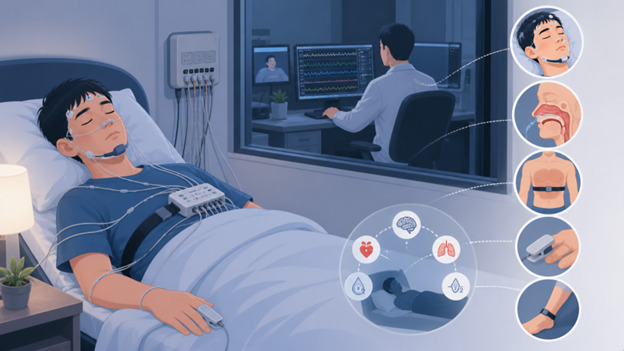
Polysomnography (PSG) is the gold standard diagnostic test for sleep apnea. Unlike HST, PSG is performed overnight in a sleep laboratory or hospital-based sleep center. A sleep technologist monitors you throughout the night, and the study captures far more data.
When you arrive at the sleep center (typically around 8:00 PM to 9:00 PM), a technologist attaches approximately 20 sensors to your body. Do not worry – this sounds intimidating but is painless. The sensors include:
- EEG electrodes (on your scalp, held with paste or tape) to measure brain waves
- EOG electrodes (near your eyes) to track eye movements and identify REM sleep
- EMG electrodes (on your chin and legs) to measure muscle tone and detect leg movements
- ECG electrodes (on your chest) to monitor heart rhythm
- Nasal pressure transducer and thermistor to measure airflow
- Respiratory belts (chest and abdomen) to measure breathing effort
- Pulse oximeter (on your finger) to measure oxygen and heart rate
- Snore microphone (taped to your throat)
- Body position sensor
You then try to sleep as normally as possible in a private, hotel-like room. The technologist watches you from a nearby control room on video and audio monitors. If your sleep apnea is severe, the technologist may wake you in the middle of the night to start a CPAP trial (called a split-night study).
In the morning (around 6:00 AM), the technologist wakes you and removes the sensors. You go home. A sleep physician or ENT specialist with sleep medicine training interprets your study over the following days.
What an In-Lab Study Reveals That Home Testing Cannot
The additional sensors in a PSG provide rich information that an HST simply cannot capture:
- Sleep architecture: PSG shows exactly how much time you spend in each sleep stage (N1, N2, N3 deep sleep, and REM). This reveals whether sleep apnea is robbing you of restorative sleep.
- Arousal index: This counts how many times your brain briefly wakes up (arousals) per hour of sleep. A high arousal index with normal AHI suggests a different sleep disorder.
- REM-specific AHI: Many people have sleep apnea that is much worse during REM sleep. PSG quantifies this. If your REM AHI is high but non-REM AHI is normal, you still need treatment.
- Supine vs. non-supine AHI: PSG shows whether your apnea worsens when you sleep on your back (supine) versus your side. This helps determine if positional therapy could help you.
- Leg movement index: PSG detects periodic limb movements of sleep (PLMS), which can mimic or coexist with sleep apnea.
- Carbon dioxide monitoring: For patients suspected of central sleep apnea or hypoventilation syndromes, PSG can measure transcutaneous CO2.
Drug-Induced Sleep Endoscopy (DISE) – The ENT Specialist's Secret Weapon
What Is DISE and Why Is It Different?
Home sleep tests and in-lab PSG tell you whether you have sleep apnea and how severe it is. But they do not tell you where your airway is collapsing. This is a critical gap because different collapse patterns require different treatments.
Drug-induced sleep endoscopy (DISE) solves this problem. DISE is a procedure performed by an ENT specialist in an operating room or procedure suite. You receive mild intravenous sedation (propofol or similar) to induce sleep that closely mimics natural sleep. Once you are asleep, the ENT specialist passes a flexible endoscope through your nostril and observes your airway in real time.
Using DISE, your ENT specialist can identify the exact level(s) of collapse:
- Palatal collapse: The soft palate and uvula fall backward, blocking the nasopharynx
- Tongue base collapse: The back of the tongue falls into the throat, obstructing the oropharynx
- Lateral pharyngeal wall collapse: The side walls of the throat cave inward
- Epiglottic collapse: The epiglottis (the leaf-shaped cartilage that protects your windpipe) flops backward over the airway
- Multilevel collapse: Two or more levels collapse simultaneously (very common)
Who Needs DISE?
Not every sleep apnea patient requires DISE. Your ENT specialist will recommend DISE if:
- You have failed CPAP therapy (cannot tolerate it or do not benefit)
- You are considering upper airway surgery (e.g., palate surgery, tongue base reduction)
- You are considering an oral appliance and need to know if your collapse pattern is favorable for this treatment
- You have persistent sleep apnea after previous surgery and need revision planning
DISE is not a first-line diagnostic test. It is reserved for patients who have already completed a sleep study and are now at the treatment decision crossroads. Many private ENT clinic locations in Singapore offer DISE.
The VOTE Classification System
During DISE, your ENT specialist uses a standardized scoring system called VOTE to describe your collapse pattern:
| Structure | Degree of Collapse (0 = none, 1 = partial, 2 = complete) | Configuration (Concentric vs. Anteroposterior vs. Lateral) |
|---|---|---|
| Velum (soft palate) | 0, 1, or 2 | AP, concentric, lateral |
| Oropharynx (lateral walls and tonsils) | 0, 1, or 2 | Lateral, concentric |
| Tongue base | 0, 1, or 2 | AP, concentric |
| Epiglottis | 0, 1, or 2 | AP, concentric |
For example, a patient might have a VOTE score of: Velum 2 (complete, AP), Oropharynx 1 (partial, lateral), Tongue base 2 (complete, AP), Epiglottis 0. This tells the ENT specialist exactly which surgeries or devices are likely to help.
Putting It All Together – From Diagnosis to Treatment Plan
The Complete Diagnostic Pathway
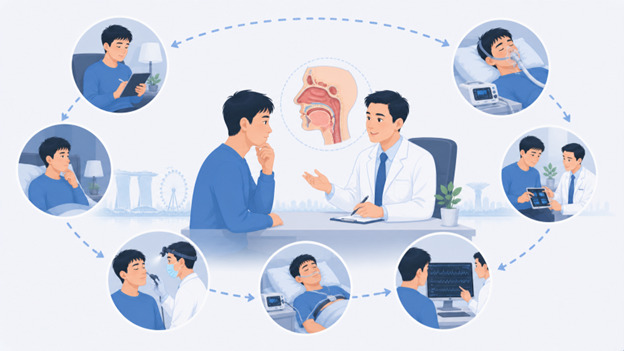
Here is how all the pieces fit together in a Singapore ENT clinic:
Step 1: Initial consultation (30-45 minutes)
- History and physical examination
- STOP-BANG screening
- Nasal endoscopy to assess anatomy
Step 2: Diagnostic testing
- Low suspicion → Lifestyle advice, no testing
- Moderate suspicion → Home sleep test (HST)
- High suspicion or comorbidities → In-lab polysomnography (PSG)
Step 3: Result interpretation
- No sleep apnea (AHI <5) → Reassess for other causes of symptoms
- Mild sleep apnea (AHI 5-15) → Discuss lifestyle changes, optional treatment
- Moderate to severe sleep apnea (AHI >15) → Treatment discussion, strongly recommended
Step 4: Advanced evaluation (if needed)
- Failed CPAP trial or considering surgery → Drug-induced sleep endoscopy (DISE)
- Abnormal anatomy identified → Surgical consultation
Step 5: Treatment plan
- CPAP, oral appliance, positional therapy, lifestyle changes, surgery, or combination
Real Patient Example – Mr. Tan, Age 52, Singapore
To make this concrete, consider a typical patient seen at an ENT clinic in Singapore:
Background: Mr. Tan is a 52-year-old Chinese Singaporean, BMI 28, works as a financial analyst, long hours, high stress. His wife reported loud snoring and witnessed breathing pauses.
Initial visit: STOP-BANG score 6 (snore, tired, observed apnea, hypertension, age >50, neck 42 cm). Nasal endoscopy showed mild nasal congestion but no polyps or severe deviation. Tonsils were large (Grade 3 out of 4).
Home sleep test: AHI 28 per hour, oxygen nadir 82%, T90 of 12 minutes. Severity: Moderate to severe sleep apnea.
DISE (ordered because Mr. Tan wanted to avoid CPAP): Showed complete concentric palatal collapse and partial tongue base collapse. No epiglottic involvement.
Treatment plan: Given the large tonsils and palatal collapse pattern, Mr. Tan underwent tonsillectomy plus uvulopalatopharyngoplasty (UPPP). Post-surgery home sleep test showed AHI 9 – a 68% reduction. He still has mild sleep apnea but now manages with positional therapy (sleeping on his side) and feels dramatically better.
Without DISE, Mr. Tan might have been prescribed CPAP (which he would have struggled to tolerate) or an oral appliance (unlikely to help with his particular collapse pattern). The comprehensive ENT specialist evaluation led to a successful surgical outcome.
Conclusion – Diagnosis Is the Gateway to Treatment
Sleep apnea is not a vague condition. It is a measurable, quantifiable disease. The numbers on your sleep study – your AHI, your oxygen nadir, your arousal index – tell a precise story about what happens to your body every night. But numbers alone do not tell the whole story. The anatomy of your collapse, visualized through endoscopy and DISE, completes the picture.
An ENT specialist in Singapore is uniquely positioned to guide you through this diagnostic journey. They can order the right test (HST vs. PSG), interpret the results in the context of your physical examination, and if needed, perform advanced procedures like DISE to map your airway collapse exactly.
By the time you complete the diagnostic process, you and your ENT specialist will know:
- Whether you have sleep apnea (yes or no)
- How severe it is (mild, moderate, or severe)
- Where your airway collapses (palate, tongue, lateral walls, epiglottis – or multiple levels)
- What treatments are most likely to succeed
Armed with this knowledge, you are ready to move forward. In Article 3, we will explore the full range of sleep apnea treatments available in Singapore: CPAP, oral appliances, lifestyle changes, and surgical options. Your ENT specialist will help you choose the right path.
But first, complete the diagnosis. If you scored 3 or higher on the STOP-BANG questionnaire, visit https://drkhliment.com.sg/sleep-apnea-singapore-treatment-surgery/ to schedule an appointment for consultation with an ENT doctor. The test is straightforward. The answers are waiting.