
Living with Sleep Apnea in Singapore: An ENT Specialist's Long-Term Success Plan
Introduction: Treatment Is Not a Destination – It Is a Journey
You have come a long way. You recognized the symptoms of sleep apnea. You completed the diagnostic journey with your ENT specialist. You chose a treatment path – whether CPAP, an oral appliance, positional therapy, or surgery. You have started treatment, and you are already feeling better. Your snoring has quieted or disappeared. Your daytime fatigue is lifting. Your bed partner is sleeping through the night. You have your life back.
But here is a truth that many patients do not anticipate: treatment is not a one-time fix. Sleep apnea is a chronic condition. Like high blood pressure or diabetes, it requires ongoing management. The CPAP pressure that works today may need adjustment in five years if you gain weight. The oral appliance that fits perfectly may wear out after 18 months. The surgery that cured your apnea may see partial recurrence if you develop new health problems.
This is the fourth and final article in our series on sleep apnea in Singapore. You will learn how to monitor your treatment over the long term, how to handle common setbacks, how to travel with your equipment, and how to know when it is time to revisit your ENT specialist. By the end, you will have a complete roadmap for living well with sleep apnea for decades to come.
Let us begin with the most important long-term habit: tracking your progress.
Monitoring Your Treatment – Are You Still on Track?
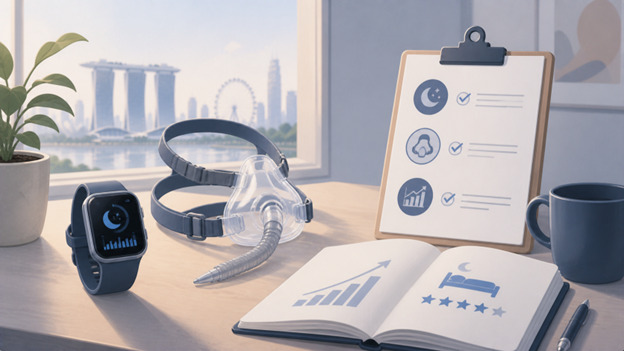
Subjective Monitoring – How You Feel Matters
The simplest way to know if your sleep apnea treatment is working is to ask yourself these questions every few weeks:
- Do I wake up feeling reasonably refreshed most mornings?
- Do I make it through the workday without fighting to stay awake?
- Do I fall asleep within 15-20 minutes of lying down at night (not instantly, which can indicate residual sleep debt)?
- Does my bed partner report that I no longer snore or gasp?
- Do I still need afternoon naps? (One short power nap is fine; daily prolonged naps suggest inadequate treatment)
- Has my spouse noticed a change in my mood, energy, or patience?
If you answer “yes” to most of these, your treatment is likely effective. But subjective feelings can be misleading. Some patients feel subjectively better even when their sleep apnea has only partially improved. That is where objective monitoring comes in.
Objective Monitoring – Let the Numbers Guide You
For CPAP users: Modern CPAP machines are smart. They record your usage hours, mask leaks, residual AHI, and even snoring intensity. Most machines upload this data to a cloud platform that your ENT specialist or CPAP provider can access. You can also view summary data on the machine’s screen or a smartphone app.
What to look for in your CPAP data:
| Metric | Target | Action if Abnormal |
|---|---|---|
| Usage hours | > 6 hours per night, > 70% of nights | Address mask discomfort, noise, or other barriers |
| Residual AHI | < 5 events per hour | Contact ENT specialist for pressure adjustment |
| 95th percentile leak | < 24 L/min | Replace mask cushion, try different mask |
| Large leak time | < 10% of night | Consider full-face mask if mouth leaking |
Most CPAP providers in Singapore offer free or low-cost data reviews every 6-12 months. Your ENT clinic may also download your data during follow-up visits.
For oral appliance users: Oral appliances do not have internal monitors. You need to repeat a home sleep test or in-lab sleep study 3-6 months after starting oral appliance therapy. Your ENT specialist will compare your new AHI to your diagnostic AHI. A successful oral appliance reduces AHI by at least 50% and brings your AHI below 15 (or below 5 if you had mild apnea).
For surgical patients: If you underwent UPPP, tongue base surgery, HGNS, or MMA, your ENT specialist will order a repeat sleep study 3-6 months after surgery. This confirms the surgical outcome and establishes a new baseline. If your AHI remains above 15 despite surgery, you may need additional treatment (often CPAP at a lower pressure).
When to Return to Your ENT Specialist for Reassessment
Do not wait for your annual physical. Schedule a follow-up with your ENT specialist if any of these occur:
- Your symptoms return (snoring, daytime sleepiness, morning headaches)
- You gain or lose more than 10% of your body weight
- You develop a new medical condition (heart disease, stroke, diabetes)
- You start taking sedatives, opioids, or muscle relaxants regularly
- You have new dental work that affects your oral appliance fit
- Your CPAP machine reports rising residual AHI despite good mask fit
- You are simply not sure if your treatment is still working
Many ENT clinic practices in Singapore offer annual follow-up appointments specifically for sleep apnea maintenance. Treat these as non-negotiable.
The Weight Battle – Managing Your Biggest Risk Factor Long-Term
Why Weight Regain Is the Most Common Cause of Treatment Failure
You lost 10 kilograms. Your sleep apnea improved from severe to mild. Your CPAP pressure dropped. You felt amazing. Then life happened. A stressful project at work. Fewer trips to the gym. More hawker centre meals. Slowly, the weight crept back. By the time you regained 8 kilograms, your snoring had returned. Your CPAP machine showed a rising residual AHI. You felt tired again.
Weight regain is the single most common reason for sleep apnea treatment failure over the long term. It is not a moral failing. It is biology. The body fights to return to its highest sustained weight. Your ENT specialist understands this. Shame has no place here. But proactive management does.
Realistic Weight Management Strategies in the Singapore Context
Work with a dietitian: Unlike generic internet advice, a dietitian can help you navigate Singapore’s unique food environment. You do not need to give up chicken rice or laksa entirely. You need portion control strategies, lower-calorie swaps, and meal timing adjustments. Polyclinic dietitians are subsidised ($20–$50 per session). Private dietitians cost $80–$150 per session.
Find movement you enjoy: The gym is not the only answer. Singapore has excellent infrastructure for walking, jogging, cycling, swimming, and group sports. The PCN (Park Connector Network) allows you to walk or cycle across the island. ActiveSG facilities offer subsidised gym and pool access ($2–$5 per visit for citizens). The key is consistency, not intensity.
Consider weight loss medications: Newer medications such as semaglutide (Wegovy, Ozempic) and tirzepatide (Mounjaro) produce an average weight loss of 15–20% of body weight, which can be enough to significantly improve sleep apnea. These medications are available in Singapore with a prescription. Costs range from S$300 to S$800 per month and are not typically covered by insurance when prescribed for weight loss alone. Your ENT specialist can refer you to an endocrinologist or a weight management physician.
Bariatric surgery (repeat): For patients with BMI above 35 who have failed medical weight loss, bariatric surgery remains the most effective long-term weight management tool. As noted in Article 3, gastric bypass or sleeve gastrectomy reduces AHI by 50-75% and often cures sleep apnea entirely. Speak to your ENT specialist about a referral to a bariatric surgery programme.
Traveling with Sleep Apnea – Exploring the World Without Losing Sleep
Flying with CPAP – Know Your Rights
Singaporeans love to travel. Whether it is a short trip to Kuala Lumpur, a holiday in Tokyo, or a long-haul flight to London or New York, you do not need to leave your CPAP behind.
Flying with CPAP (carry-on): CPAP machines are medical devices. They do not count toward your carry-on baggage allowance. International aviation regulations require airlines to allow CPAP as an additional free carry-on item. When booking your flight, notify the airline that you will be traveling with a CPAP machine. Most airlines ask you to complete a “Medical Device Declaration” form. At security screening, you may need to remove the CPAP from its bag for separate X-ray. The machine can be X-rayed without damage.
Using CPAP on the plane: On long-haul flights (usually over 8 hours), aircraft cabins have electrical outlets compatible with CPAP machines. You will need an international plug adapter and possibly a power inverter. Some CPAP machines have battery packs (see below). Notify the airline in advance – some require medical clearance for in-flight CPAP use.
CPAP without electricity: For camping, power outages, or flights without outlets, you need a CPAP battery. CPAP-specific batteries (e.g., Medistrom Pilot-24, ResMed Power Station II) cost S$400-1,000 and can power your machine for 1-3 nights. Distilled water is not essential for short trips – you can use bottled or tap water for one night without significant mineral buildup.
Renting CPAP at your destination: If you prefer not to travel with your machine, ENT clinic locations and CPAP providers in many countries offer rental CPAP machines. Research ahead of time. Bring your prescription (most CPAP providers require a copy).
Oral Appliances for Travel
Oral appliances are far easier to travel with than CPAP. They fit in a small plastic case about the size of a glasses case. No electricity, no water, no tubing. However, remember to pack your appliance in your carry-on bag, not checked luggage. Losing your oral appliance mid-trip would mean several nights of untreated sleep apnea in a hotel – not ideal for you or your sleep-deprived travel companions.
If you wear an oral appliance, also pack:
- The appliance case (to protect it when not in use)
- A soft toothbrush for cleaning (no toothpaste on the appliance – it can be abrasive)
- Your dentist’s contact information in case the appliance breaks
- A backup boil-and-bite appliance (available at pharmacies) for absolute emergencies
Time Zone Changes and Sleep Apnea
Crossing multiple time zones disrupts your sleep schedule. If you have sleep apnea , the jet lag effect is magnified because your fragmented sleep is already fragile. Some practical tips:
- Adjust your CPAP clock: If your CPAP machine has an internal clock for data tracking, change it to local time as soon as you arrive. This keeps your usage data accurate.
- Use CPAP during naps: Jet lag often leads to daytime napping. Use your CPAP during naps. Apneas occur during any sleep, not just nighttime sleep.
- Be patient with yourself: It may take 2-3 days longer to adjust to a new time zone than your travel companions without sleep apnea. Build in recovery time.
Dealing with Treatment Setbacks – Common Problems and Solutions
CPAP – When Things Go Wrong After Months of Success
You have been a model CPAP user for two years. Then suddenly, you cannot tolerate it anymore. This happens. Do not give up. Work through this checklist:
Problem: Mask leaks have worsened
- Replace your mask cushion (cushions wear out every 3-6 months)
- Check that your headgear straps have not stretched
- Wash your face before bed (facial oils cause leaks)
- Consider a different mask model (your needs may have changed)
Problem: Pressure feels too high or too low
- Weight gain or loss changes pressure requirements
- Request a CPAP data download review by your ENT specialist
- If your machine is an auto-CPAP (APAP), ensure the pressure range is still appropriate
Problem: Nasal congestion makes CPAP impossible
- Add or increase heated humidification
- Use saline spray before bed
- Ask your ENT specialist about nasal steroid sprays (fluticasone, mometasone)
- Consider evaluation for chronic sinusitis or nasal polyps
Problem: You just stopped using it (no single reason)
- This is the most common CPAP failure pattern – gradual abandonment
- Schedule a “CPAP restart” appointment with your ENT clinic
- Try a different mask (many patients succeed with a second or third mask type)
- Consider cognitive behavioural therapy for CPAP adherence (available in Singapore through sleep psychologists)
Oral Appliance – Signs of Trouble
Problem: Jaw pain in the morning
- Your appliance may be advancing your jaw too far
- Your ENT specialist or dental sleep specialist can adjust the advancement incrementally
- Jaw stretching exercises before bed can reduce stiffness
Problem: Your bite feels different during the day
- Oral appliances can cause minor, usually temporary, changes in your bite
- If your teeth do not touch comfortably when the appliance is removed, see your dentist
- Bite changes typically resolve within 1-2 hours. If persistent, the appliance may need modification or discontinuation.
Problem: The appliance no longer fits (new dental work, natural tooth movement)
- Do not force a poorly fitting appliance – it can damage teeth or gums
- Schedule a new dental impression and replacement appliance
- Expect to replace custom oral appliances every 3-5 years
Surgery – Handling Recurrence
Surgical outcomes can change over time. If you had successful sleep apnea surgery (AHI reduced by 50-70%) but your symptoms have returned years later, do not assume the surgery failed. More likely, something else changed:
- Weight gain (the most common cause of late recurrence)
- New medication (sedatives, muscle relaxants)
- New medical condition (hypothyroidism, acromegaly)
- Age-related loss of muscle tone
Your ENT specialist will repeat a sleep study and potentially repeat DISE to reassess your anatomy. Options include:
- Resuming CPAP (often at lower pressure than before surgery)
- Oral appliance therapy
- Revision surgery (more complex, but possible)
Support Systems – You Are Not Alone
The Role of Your Bed Partner
Your spouse or partner is not just a witness to your sleep apnea – they are an essential member of your treatment team. They notice when your snoring returns. They can remind you to use your CPAP when you are tempted to skip it. They can provide encouragement during frustrating periods.
Involve your partner in your follow-up appointments. Ask your ENT specialist to explain the treatment plan to both of you. When your partner understands why CPAP matters (heart health, stroke prevention, dementia risk), they become your ally, not your nag.
Sleep Apnea Support Groups in Singapore
Several communities exist for sleep apnea patients in Singapore:
- CPAP Singapore User Group (Facebook): An active community of over 5,000 members sharing tips, troubleshooting advice, and equipment recommendations.
- Sleep Apnea Association Singapore (SAAS): A non-profit organisation offering educational events, support group meetings, and advocacy for sleep apnea awareness. Contact them through their website for meeting schedules.
- Hospital-based support groups: Singapore General Hospital and National University Hospital occasionally offer patient education seminars and support groups. Ask your ENT specialist or sleep centre coordinator.
Online forums (Reddit’s r/SleepApnea, CPAPTalk.com) are also valuable resources, especially for troubleshooting specific equipment issues. However, always verify medical advice with your own ENT specialist – what worked for a stranger in another country may not be appropriate for you.
Mental Health – The Overlooked Aspect of Sleep Apnea Care
Sleep apnea and mental health are deeply connected. Chronic sleep deprivation causes or worsens depression, anxiety, and irritability. Conversely, depression can reduce motivation to use CPAP or attend follow-up appointments. The relationship is bidirectional.
If you struggle with mood, energy, or motivation even after successful sleep apnea treatment, you may need separate mental health support. Singapore has resources:
- Polyclinic mental health services (subsidised counselling and medication)
- Institute of Mental Health (IMH) (specialised psychiatric care)
- Private psychologists and psychiatrists (S$150-400 per session)
- Mental health apps (Mindline.sg, Intellect, ThoughtFull)
Do not ignore your mental health in the pursuit of sleep apnea treatment. The two must be addressed together.
Long-Term Health Monitoring Beyond Sleep Apnea
Cardiovascular Surveillance
Because sleep apnea dramatically increases your risk of hypertension, heart attack, and stroke, you need regular cardiovascular monitoring even after your sleep apnea is well treated.
- Blood pressure checks: At least every 6-12 months. Home blood pressure monitors are affordable (S$50-150) and reliable.
- Cholesterol screening: Annually, especially if you have other risk factors.
- ECG: Your GP may recommend a baseline ECG if you have severe sleep apnea or cardiac symptoms.
If your sleep apnea was diagnosed after a stroke or heart attack, your cardiologist should be aware of your sleep apnea treatment status. Effective CPAP use reduces recurrent cardiovascular events by 30-40%.
Driving Safety
Singapore has no mandatory reporting requirement for sleep apnea patients to the Land Transport Authority (LTA). However, driving while untreated or poorly treated sleep apnea is dangerous. The law requires you to be fit to drive. If you have untreated sleep apnea with daytime sleepiness, you are not fit to drive.
Once you are on effective treatment (documented by a repeat sleep study showing AHI <15 and adherence to CPAP >6 hours per night), your driving risk returns to near-baseline. Keep a copy of your treatment documentation in your glove compartment in case you are ever in an accident and your sleep apnea history is questioned.
If you are a commercial driver (taxi, bus, lorry, private hire), the LTA may request medical clearance. Your ENT specialist can provide a letter confirming that your sleep apnea is treated and controlled.
Dental Health for Oral Appliance Users
If you use an oral appliance for sleep apnea , see your dentist every 6-12 months. The dentist will check for:
- Tooth movement (the appliance can slowly shift teeth over years)
- Gum recession (excessive pressure on the gums)
- Changes in your bite (malocclusion)
- Wear and tear on the appliance itself
Most dental sleep specialists recommend replacing custom oral appliances every 3-5 years, even if they appear intact, due to material fatigue.
When to Consider Changing Treatments – Even Years Later
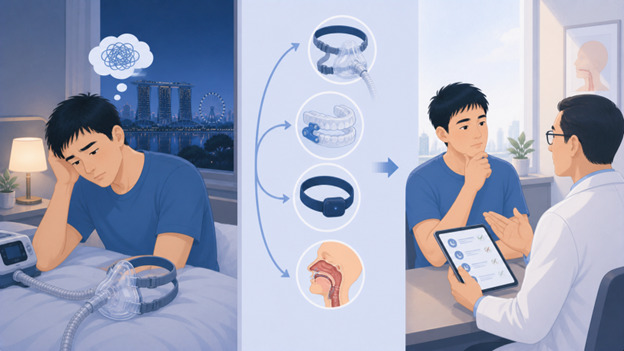
From CPAP to Surgery
Some patients use CPAP faithfully for years but eventually grow tired of the nightly ritual. If you are a CPAP user who is willing to consider surgery for sleep apnea , your ENT specialist will reassess you as if you were a new patient:
- Repeat sleep study (to confirm that your sleep apnea severity is stable)
- Nasal endoscopy (to reassess anatomy)
- DISE (to map collapse patterns)
Even if you were not a surgical candidate years ago, you may be now. Your anatomy may have changed (tonsils may have enlarged further, or weight gain may have increased tongue base collapse). Alternatively, new surgical techniques (HGNS, ESP) may be available now that were not previously.
From CPAP to Oral Appliance
Mild to moderate sleep apnea patients who start on CPAP but want a more portable option can transition to an oral appliance. Your ENT specialist will order a sleep study with the oral appliance in place to confirm efficacy. Some patients use CPAP at home and an oral appliance for travel – a perfectly reasonable hybrid approach.
Treatment Escalation for Worsening Apnea
If your sleep apnea worsens over time (higher AHI on follow-up testing) despite good adherence to your current treatment, you may need to escalate:
- Mild → moderate: Oral appliance may become insufficient; CPAP may be needed
- Moderate → severe: CPAP pressure may need significant increase; consider HGNS or MMA
- Severe with complications (heart failure, severe hypoxia): Urgent reassessment by ENT specialist ; consider inpatient CPAP titration or surgical consultation.
Conclusion – A Lifetime of Better Sleep
Sleep apnea is not a death sentence. It is not even a life sentence of misery. With proper diagnosis, appropriate treatment, and ongoing management, you can live a full, energetic, healthy life. You can travel the world. You can advance in your career. You can be present for your family. You can wake up each morning feeling like yourself.
The key is partnership. You and your ENT specialist are a team. You bring your willingness to follow through. They bring their medical expertise, their surgical skills, and their commitment to your long-term success. Together, you will monitor your progress, adjust to life’s changes, and catch problems before they become crises.
This four-part series has given you the complete roadmap:
- Article 1: Recognising the sleep apnea crisis in Singapore and identifying your risk
- Article 2: Navigating the diagnostic process from home sleep test to DISE
- Article 3: Understanding every treatment option from CPAP to HGNS to MMA
- Article 4: Living successfully with sleep apnea for the long haul
Now you have the knowledge. The only remaining step is action.
If you have already started treatment, schedule your annual follow-up with your ENT doctor today. If you have been putting off that first appointment, stop waiting. Call a polyclinic for a referral, or book directly with a private Singapore ENT clinic. The first step is the hardest – but the rest of your life, well-rested and fully awake, is waiting on the other side.
Breathe easy, Singapore. You have got this.