Introduction: Why Singapore Is Battling a Silent Sleep Epidemic
Singapore is known for many things: world-class infrastructure, economic prosperity, a thriving food scene, and a population that never seems to stop moving. But beneath the surface of this bustling city-state lies a hidden health crisis that affects hundreds of thousands of Singaporeans every single night. The crisis is called sleep apnea. And most people who have it do not even know they are suffering.
Sleep apnea is a condition where your breathing repeatedly stops and starts during sleep. These pauses can last from 10 seconds to over a minute, and they can happen hundreds of times in a single night. Each time breathing stops, your brain briefly wakes you up to restart the process. You never enter deep, restorative sleep. You wake up exhausted, irritable, and foggy-headed – even after spending eight or nine hours in bed.
This article is the first in a four-part series written from the perspective of an ENT specialist treating sleep apnea in Singapore. You will learn why sleep apnea is so common in this country, what symptoms to watch for, and how to take the first step toward diagnosis and treatment.
By the end of this series, you will have a complete, step-by-step roadmap to reclaiming your sleep and your health.
Let us begin by understanding the scope of the problem.
Understanding Sleep Apnea – More Than Just Loud Snoring
What Exactly Is Sleep Apnea?
The word “apnea” comes from Greek, meaning “without breath.” Sleep apnea is exactly that: episodes without breathing during sleep. There are three main types, but one dominates the discussion in Singapore:
Obstructive Sleep Apnea (OSA): This is the most common form, affecting over 85% of sleep apnea patients. OSA occurs when the muscles in the back of your throat relax too much during sleep. These muscles support the soft palate, the uvula, the tonsils, and the tongue. When they relax, your airway narrows or closes completely. You try to breathe, but air cannot get through. Your oxygen level drops. Your brain senses the danger and briefly wakes you up – often with a gasping, choking, or snorting sound – so you can reopen your airway. You fall back asleep, and the cycle repeats.
Central Sleep Apnea (CSA): This is much rarer. CSA occurs when your brain does not send the proper signals to the muscles that control breathing. There is no airway blockage. Instead, your body simply forgets to breathe. CSA is more common in people with heart failure, stroke survivors, or those using certain medications like opioids.
Complex Sleep Apnea Syndrome: Also called treatment-emergent central sleep apnea, this is a combination of both OSA and CSA. It is usually diagnosed when someone starts CPAP therapy for OSA and then develops central apneas.
Throughout this series, when we say sleep apnea, we are referring to obstructive sleep apnea unless specified otherwise. This is the condition that an ENT specialist in Singapore sees most often in their practice.
The Difference Between Snoring and Sleep Apnea
Many people assume that loud snoring is just annoying but harmless. This is a dangerous misconception. While not everyone who snores has sleep apnea, nearly everyone with sleep apnea does snore. The difference lies in what happens during and after the snoring.
| Feature | Simple Snoring | Sleep Apnea |
|---|---|---|
| Sound quality | Usually steady, rhythmic | Often interrupted by pauses, gasps, or snorts |
| Breathing pattern | Continuous | Repeated stops and starts |
| Daytime sleepiness | Rare or mild | Common and often severe |
| Morning headaches | Uncommon | Frequent |
| Witnessed apneas | No | Bed partner often observes breathing pauses |
| Health risks | Minimal | Heart disease, stroke, diabetes, accidents |
If your bed partner has ever told you that you stop breathing during sleep, or if you wake up gasping for air, you need to see an ENT specialist for evaluation. Snoring alone may be manageable with lifestyle changes. But sleep apnea requires active treatment.
Why Is Sleep Apnea So Common in Singapore?
The Perfect Storm of Risk Factors
Singapore has one of the highest rates of sleep apnea in Asia. Studies estimate that nearly 30% of adult Singaporeans have at least moderate sleep apnea, and many more have mild, undiagnosed disease. Why is the number so high? Several factors unique to Singapore create a perfect storm:
- High Rates of Obesity: Obesity is the single strongest risk factor for sleep apnea. Excess fat deposits around the neck and upper airway narrow the throat, making collapse during sleep more likely. According to the Health Promotion Board, the prevalence of obesity in Singapore has been rising steadily, from 8.6% in 2017 to 10.5% in 2020. As waistlines expand, airways narrow.
- Asian Facial Anatomy: This is a critical point that many ENT specialist physicians in Singapore emphasize. Compared to Caucasians, Asians – including Chinese, Malay, and Indian Singaporeans – tend to have:
- Smaller jaw bones (retrognathia)
- Steeper cranial base angles
- Larger tongue volumes relative to their mouth size
- Higher Mallampati scores (meaning the tongue and soft palate take up more space in the throat)
These anatomical differences mean that an Asian person with a normal body mass index (BMI) may still have sleep apnea because their airway is simply more crowded than a Caucasian person of the same weight.
- Urban Lifestyle and Chronic Stress: Singapore is a high-pressure society. Long working hours, competitive academic environments, and the constant pursuit of success create chronic stress. Stress elevates cortisol levels, which can disrupt sleep architecture and worsen muscle relaxation during sleep – exactly what triggers airway collapse in sleep apnea.
- Air Pollution and Nasal Congestion: While Singapore’s air quality is generally good, seasonal haze from regional forest fires can cause significant nasal inflammation. Chronic nasal congestion forces people to breathe through their mouths during sleep, which bypasses the natural airway-stabilizing effects of nose breathing. Mouth breathing increases the risk of airway collapse.
- An Aging Population: Singapore has one of the fastest-aging populations in the world. By 2030, one in four Singaporeans will be aged 65 or older. Sleep apnea becomes more common with age because the muscles in the throat lose tone and elasticity. The older you are, the higher your risk.
The Shocking Prevalence Statistics
Let us look at the numbers. A landmark study published in the Singapore Medical Journal found that among adults aged 30 to 70 years:
- 1 in 3 Singaporeans has moderate to severe sleep apnea
- 1 in 5 has severe sleep apnea (more than 30 breathing pauses per hour of sleep)
- Among men over 50, the rate exceeds 50%
- Among obese Singaporeans (BMI > 30), the rate exceeds 80%
Despite these staggering numbers, an estimated 85-90% of Singaporeans with sleep apnea remain undiagnosed. That means for every person receiving treatment at an ENT clinic or sleep center, eight to nine others are suffering in silence – completely unaware that their fatigue, snoring, and morning headaches have a treatable cause.
Signs and Symptoms – Are You at Risk?
Night time Symptoms (What Happens While You Sleep)
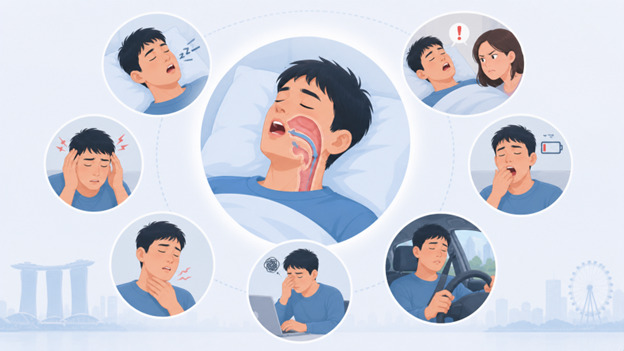
Your body gives you many clues while you sleep. You may not notice them because you are unconscious, but your bed partner certainly will. Common night time signs of sleep apnea include:
- Loud, persistent snoring that disturbs others in the room
- Witnessed breathing pauses – your partner notices you stop breathing for 10 seconds or longer, followed by a gasp or snort
- Choking or gasping sounds as you restart breathing
- Restless sleep with frequent position changes
- Night sweats (caused by the body’s stress response to low oxygen)
- Frequent trips to the bathroom at night (nocturia) – the body produces more urine when oxygen levels drop
- Teeth grinding (bruxism) – the jaw clenches or grinds as the body struggles to reopen the airway
Daytime Symptoms (What Happens When You're Awake)
The effects of sleep apnea follow you into the daylight. Even if you think you slept “okay,” fragmented sleep takes a cumulative toll. Common daytime signs include:
- Excessive daytime sleepiness – you struggle to stay awake during meetings, while driving, or during quiet activities like reading or watching TV. Many patients fall asleep within minutes if they sit still.
- Unrefreshing sleep – you wake up feeling as tired as when you went to bed, even after 8 hours in bed
- Morning headaches – caused by carbon dioxide retention and oxygen deprivation overnight
- Dry mouth or sore throat upon waking – from breathing through an open mouth all night
- Difficulty concentrating – brain fog, forgetfulness, and trouble focusing on tasks
- Irritability and mood swings – chronic sleep deprivation makes you short-tempered
- Depression and anxiety – long-term untreated sleep apnea is strongly linked to mood disorders
- Low libido and erectile dysfunction – sleep apnea disrupts hormone production
The STOP-BANG Questionnaire – A Quick Self-Assessment
ENT specialist physicians in Singapore often use a simple screening tool called STOP-BANG to identify patients who need formal sleep apnea testing. Answer these eight questions honestly:
| Letter | Question | Yes/No |
|---|---|---|
| S | Do you Snore loudly (louder than talking or loud enough to be heard through closed doors)? | |
| T | Do you often feel Tired, fatigued, or sleepy during the daytime? | |
| O | Has anyone Observed you stop breathing, choke, or gasp during sleep? | |
| P | Do you have high blood Pressure (or take medication for hypertension)? | |
| B | Is your Body Mass Index (BMI) > 35? (Calculate your BMI) | |
| A | Are you Aged over 50 years old? | |
| N | Is your Neck circumference > 40 cm (for men) or > 35 cm (for women)? | |
| G | Are you Gender male? (Men have higher risk) |
Scoring:
- Low risk: 0-2 yes answers
- Intermediate risk: 3-4 yes answers
- High risk: 5-8 yes answers
If you score 3 or higher, you have a significant chance of having sleep apnea. You should discuss these results with an ENT specialist in Singapore.
The Health Consequences of Untreated Sleep Apnea
Short-Term Consequences – Why You Feel Terrible
Even in the short term, untreated sleep apnea degrades your quality of life. The constant sleep fragmentation prevents you from reaching the deep, restorative stages of sleep known as slow-wave sleep and REM sleep. Your body cannot repair itself. Your brain cannot consolidate memories. Your emotional regulation suffers. Many patients describe their pre-treatment life as “going through the motions” – awake but not truly alive.
The daytime sleepiness from sleep apnea also dramatically increases your risk of accidents. Studies consistently show that people with untreated moderate to severe sleep apnea are 2 to 3 times more likely to be involved in a motor vehicle crash. In Singapore, where driving conditions are generally safe, sleep apnea is often the hidden factor behind unexplained “lapses in concentration” that lead to collisions.
Long-Term Consequences – The Silent Damage
If left untreated for years, sleep apnea causes progressive damage to nearly every organ system:
Cardiovascular disease: Each apnea episode causes your oxygen level to drop. Your brain responds by releasing stress hormones that spike your heart rate and blood pressure. Over years, this repeated stress leads to sustained hypertension (high blood pressure), even during the daytime. Untreated sleep apnea triples your risk of heart attack and quadruples your risk of stroke.
Heart failure: The combination of high blood pressure, low oxygen, and repeated nighttime stress responses can weaken your heart muscle over time. Sleep apnea is an independent risk factor for developing heart failure, even in people without other risk factors.
Type 2 diabetes: Sleep apnea promotes insulin resistance – the precursor to diabetes. Treating sleep apnea can improve blood sugar control in diabetic patients and may reduce the risk of developing diabetes in prediabetic patients.
Liver disease: Non-alcoholic fatty liver disease (NAFLD) is much more common in people with sleep apnea. The cycles of low oxygen damage liver cells directly.
Cognitive decline: Chronic sleep deprivation from sleep apnea accelerates brain aging. Studies show that older adults with untreated sleep apnea develop mild cognitive impairment and dementia years earlier than those without the condition.
Premature death: This is the bottom line. Multiple large-scale studies have shown that people with severe, untreated sleep apnea die significantly younger than their peers – often 10 to 15 years earlier – primarily from heart attacks and strokes.
The First Step – Seeing an ENT Specialist in Singapore
Why an ENT Specialist, Not Just a GP?
Your general practitioner (GP) in Singapore can certainly suspect sleep apnea based on your symptoms and the STOP-BANG questionnaire. Many GPs will prescribe a home sleep test or refer you to a sleep center. But there is a compelling reason to see an ENT specialist as well.
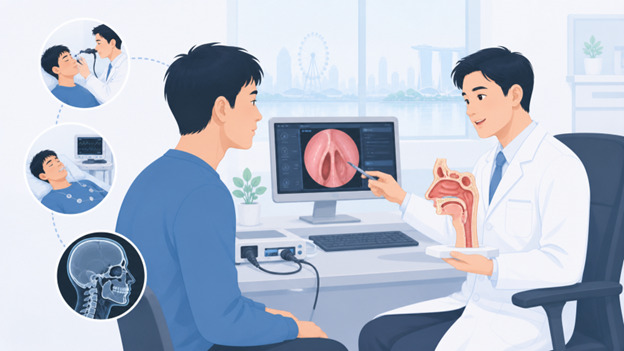
An ENT specialist is uniquely qualified to evaluate the anatomical causes of your sleep apnea. Using nasal endoscopy, the ENT specialist can visualize:
- Your nasal passages (deviated septum, turbinate hypertrophy, polyps)
- Your palate and uvula (long or floppy soft palate)
- Your tonsils (enlarged tonsils are a common cause of apnea, especially in Asian patients)
- Your tongue base (a large tongue relative to your mouth size)
- Your epiglottis (a floppy epiglottis can collapse during sleep)
This anatomical evaluation is critical because it determines which treatments will work best for you. A patient with nasal obstruction needs a different therapy than a patient with a large tongue or enlarged tonsils. A GP cannot perform this examination. An ENT clinic in Singapore is where this evaluation happens.
What to Expect at Your First ENT Clinic Visit
Your first consultation for sleep apnea at an ENT clinic in Singapore typically lasts 30 to 45 minutes. Here is what to expect:
Detailed history: The ENT specialist will ask about your snoring, witnessed apneas, daytime sleepiness, and any other symptoms. They will also ask about your medical history, medications, and lifestyle factors.
Physical examination: This includes checking your neck circumference, measuring your blood pressure, and examining your mouth and throat using a simple tongue depressor (Mallampati score).
Nasal endoscopy: The ENT specialist will pass a thin, flexible camera through your nostril to examine your entire upper airway. This takes about two minutes. They will spray a numbing medication in your nose first, so the procedure is not painful – just a little strange.
Discussion of next steps: Based on the examination, your ENT specialist will recommend either a home sleep test (if your risk is moderate) or an in-lab sleep study (if your risk is high or if you have other medical conditions). They will also discuss preliminary treatment options.
Local Resources for Sleep Apnea in Singapore
If you suspect you have sleep apnea, here are your options in Singapore:
Public healthcare (subsidized): You can see a GP at a polyclinic and request a referral to a public hospital ENT department (Singapore General Hospital, National University Hospital, Changi General Hospital, Khoo Teck Puat Hospital, or Tan Tock Seng Hospital). Wait times for subsidized ENT specialist appointments can be 2 to 6 months.
Private healthcare (faster access): You can book directly with a private ENT clinic without a referral. Private ENT specialist consultations cost $150 to $350. Private sleep studies may cost $800 to $2000. Private health insurance often covers these costs depending on your plan.
Conclusion – The First Step Is Awareness
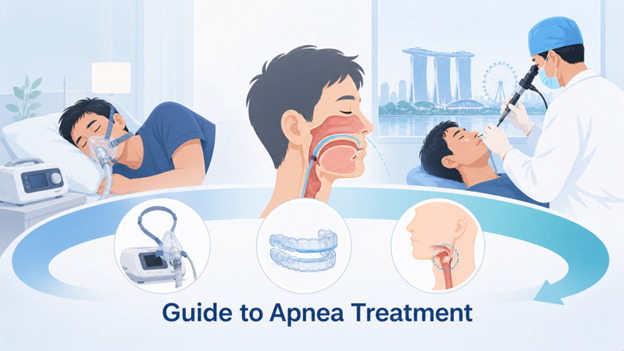
Sleep apnea is a silent epidemic in Singapore. Hundreds of thousands of people are living with this condition, unaware that their exhaustion, morning headaches, and snoring have a name and a treatment. The good news is that sleep apnea is highly treatable. CPAP machines, oral appliances, lifestyle changes, and even surgical options from an ENT specialist can restore normal breathing and normal sleep.
But none of that happens until you take the first step: recognizing that your symptoms are not normal. You are not “just a heavy snorer.” You are not “just getting older.” You are not “just stressed.” You may have sleep apnea. And help is available.
In Article 2 of this series, we will dive deeper into the diagnostic process. You will learn about home sleep tests versus in-lab sleep studies, what the numbers mean, and how an ENT specialist interprets the results to create your personalized treatment plan.
But for now, look at the STOP-BANG questionnaire again. If you scored 3 or higher, pick up your phone. Call a polyclinic or a private ENT clinic. Make that appointment. Your future self – well-rested, healthy, and fully awake – will thank you.